
The Strangler That Never Strangles - Preventing the "Permanent Hybrid" Trap
4 min read
February 12, 2026
The Deceptive Velocity of Early Migration
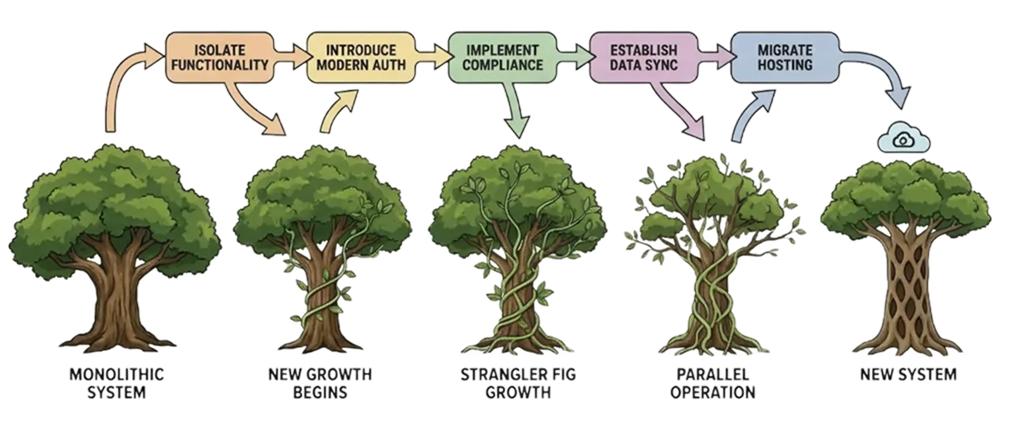
The Strangler Fig pattern—incrementally replacing specific functionality of a legacy system with new applications/services—is widely regarded as the lowest-risk modernization strategy. In practice, however, this approach introduces a specific failure mode: the "Permanent Hybrid" state. This occurs when a migration project stalls after the easy, peripheral features are moved, leaving the core business logic trapped in the legacy environment indefinitely.
The initial phase of a Strangler Fig implementation is often deceptive. Teams naturally target low-coupling, high-value modules first, such as reporting dashboards or distinct user interfaces. These early wins create an illusion of linear progress. Stakeholders assume the remaining migration will proceed at the same velocity, failing to account for the increasing density of dependencies in the system’s core.
When the modernization effort reaches the complex, tightly coupled logic—often the 20% of code responsible for 80% of critical transactions—velocity plummets. If the organization treats this deceleration as a performance failure rather than a structural reality, they often pull resources. This leaves the organization supporting two disparate systems, effectively doubling the operational surface area.
The Economics of the "Pareto Stall"
The primary driver of the Permanent Hybrid trap is a misalignment of business value and technical effort. As the migration progresses, the "cost to migrate" for the remaining features increases exponentially, while the perceived "value added" diminishes.
For a Director of Operations, the system appears functional at 80% completion. The new platform handles the majority of user traffic, while the legacy system quietly handles the difficult edge cases and back-office processing. From a purely functional standpoint, the urgency to finish the migration evaporates. The budget is reallocated to new initiatives, and the "temporary" bridge between the two systems becomes permanent infrastructure.
This stall is often financially invisible in the short term but devastating in the long term. As detailed in our analysis of Stabilize vs. Replace decisions, the cost of maintaining the integration layer—keeping data synchronized between the old and new worlds—eventually exceeds the cost of the original legacy maintenance.
The Operational Tax of Dual-Stack Maintenance
Operating a Permanent Hybrid environment imposes a severe cognitive tax on engineering teams. Instead of simplifying the stack, the organization has introduced a distributed system problem on top of a legacy maintenance problem.
In this state, data consistency becomes the primary operational risk. Because the "source of truth" is split between the modernized services and the legacy database, synchronization scripts and anti-corruption layers become critical infrastructure. These integration points are rarely designed for longevity, yet they often remain in production for years, becoming brittle points of failure that require constant manual intervention.
Furthermore, this state exacerbates the knowledge concentration risk the modernization was intended to solve. The organization now requires engineers who understand the modern stack, engineers who understand the legacy stack, and—most critically—architects who understand the complex web of glue code holding them together.
Enforcing the "Kill Switch"
To prevent the Strangler Fig from becoming a parasite that feeds on the budget without killing the host, leadership must define the "kill switch" criteria before the first line of code is rewritten.
Successful execution requires decoupling the deployment of the new system from the decommissioning of the old. There must be a rigid schedule for shutting down legacy capabilities, regardless of the difficulty involved in migrating the final 20%. This often requires Enterprise Architecture governance to enforce "sunset dates" where legacy subsystems are read-only or inaccessible, forcing the migration of the final, difficult logic.
Without a firm commitment to full decommissioning, the Strangler Fig is not a replacement strategy; it is merely an expensive way to increase technical debt.
Conclusion
The Strangler Fig pattern is effective only if the strangulation is completed. Stopping at partial completion creates a Permanent Hybrid state that combines the rigidity of the legacy system with the distributed complexity of the new one. To avoid this, technical leadership must anticipate the "Pareto Stall," budget for the disproportionate effort of the final mile, and enforce the retirement of the legacy system as a non-negotiable project deliverable.