

Revenue-Engineered B2B Websites
We build revenue-engineered B2B websites designed for search authority, buyer intent, CRM integration, and measurable pipeline growth.

We help B2B companies automate their revenue operations — from lead capture and qualification to pipeline management and attribution. By building connected marketing automation, data infrastructure, and intelligent revenue systems, we replace manual processes and disconnected tools with scalable infrastructure that improves conversion rates, sales visibility, and pipeline efficiency.

Most revenue bottlenecks don’t start with a lack of leads.
They start with what happens after those leads enter the system.
On the surface, activity looks healthy. Campaigns are running. Forms are filling. Sales teams are busy. But conversion is inconsistent, follow-up varies, and pipeline performance feels unpredictable. The issue isn’t effort — it’s flow.
Manual lead handling introduces delay at exactly the wrong moment. Routing depends on human intervention. Qualification criteria shift from rep to rep. Context gets lost between tools. By the time a lead reaches the right person, momentum has already faded.
Attribution adds another layer of confusion. Reports exist, but they don’t answer the questions leadership actually cares about. Data conflicts across platforms. “Source of truth” becomes a debate instead of a metric. Decisions are made based on partial or misleading signals.
As systems grow, tools accumulate. Marketing platforms, CRMs, enrichment tools, analytics, sales software — each solves a narrow problem, but few are designed to work together cleanly. The result is a fragmented revenue stack where no one owns the full journey from first touch to closed deal.
When this happens, teams often push harder on tactics: more campaigns, more spend, more activity. But volume rarely fixes structural problems. Without a connected system, reporting answers the wrong questions, and optimization efforts target symptoms instead of causes.
This is why revenue bottlenecks often feel frustratingly hard to diagnose.
They aren’t caused by people underperforming — they’re caused by systems that were never designed to operate as a whole.
If this feels familiar, it’s a signal that the issue isn’t marketing execution.
It’s revenue infrastructure.
Revenue systems break down not because teams lack effort, but because critical processes are handled inconsistently, manually, or across disconnected tools. The areas below represent the most common points of friction we see in growing B2B organizations — and where automation delivers the greatest leverage.
Speed and consistency at the top of the funnel matter more than volume alone.
We automate how leads are captured, enriched, routed, and qualified so that high-intent prospects are handled quickly and predictably. Routing logic replaces manual assignment. Qualification criteria are applied consistently. Follow-up no longer depends on who happens to be available at the moment a lead comes in.
The result is faster response times, clearer ownership, and fewer leads lost in transition. Leads from channels like search engine optimization require the same routing and qualification discipline as any other source.
As funnels mature, static nurture sequences stop reflecting real buyer behavior.
Lifecycle orchestration often includes email marketing tied to behavioral triggers and stage transitions, rather than static campaigns. Behavioral triggers guide prospects through the funnel based on intent and engagement, while stage transitions remain visible and auditable across teams.
This creates a revenue motion that adapts as buyers move, instead of forcing them through rigid paths.
Disconnected systems create inconsistent data and unreliable reporting.
We automate synchronization between CRMs, marketing platforms, enrichment tools, and analytics systems to establish a clear source of truth. Manual updates are removed. Conflicting records are reduced. Teams stop reconciling spreadsheets and start trusting their data.
When systems stay aligned, reporting becomes easier — and decisions become more defensible.
Most attribution models answer tactical questions, not strategic ones.
We build analytics pipelines that reflect the full buyer journey, accounting for multi-touch reality across channels and time. Revenue signals are tied back to meaningful actions, not just last-click events.
This enables executive-ready reporting that explains what actually drives the pipeline and where investment produces real return.
Sales teams lose time to administrative work that doesn’t move deals forward.
We automate task creation, prioritization, and outreach signals so reps focus on the right actions at the right time. Outreach becomes event-driven instead of reactive. Context travels with the lead instead of living in separate tools.
This reduces rep overhead while improving consistency and follow-through.
Revenue systems shouldn’t require constant monitoring to catch problems.
We implement alerts and signals that surface issues early — pipeline drop-offs, stalled opportunities, declining conversion rates, or abnormal patterns. Instead of reacting after numbers miss targets, teams are notified when intervention is still possible.
Automation here isn’t about dashboards — it’s about actionable awareness.
Point solutions are rarely a mistake — they’re often the right decision at the time. As teams grow, new tools are added to solve specific problems: lead capture, email, enrichment, analytics, CRM, and sales engagement. Each tool promises efficiency. Over time, the stack expands.
The problem isn’t the tools themselves. It’s what happens when those tools are never designed to function as a system.
As revenue operations become more complex, disconnected solutions introduce friction instead of leveraging. Processes rely on manual coordination. Data loses consistency. Ownership becomes unclear. At a certain scale, adding another tool stops improving outcomes and starts amplifying inefficiency.
Tool sprawl creates invisible costs long before it shows up in budget line items.
Overlapping platforms generate conflicting data. Integrations become fragile and difficult to maintain. Small changes in one system ripple unpredictably through others. When something breaks, it’s unclear who owns the fix — marketing, sales, operations, or engineering.
As a result, teams spend more time reconciling information than acting on it. Reporting becomes a debate instead of a reference point. Confidence in the numbers erodes, even when effort and spending increase.
At this stage, teams often need custom software development to replace brittle integrations and enforce consistent revenue logic.
When revenue performance stalls, the instinct is often to increase volume.
More campaigns. More spending. More leads.
But volume doesn’t fix structural issues. Leaky funnels remain leaky. Follow-up stays are inconsistent. High-intent prospects still get delayed or mishandled. Misaligned incentives between teams continue to undermine conversion.
In these situations, more leads don’t improve performance — they mask inefficiency. Activity increases, but outcomes don’t. The underlying system remains unchanged, and frustration grows as effort fails to translate into predictable results.
There are clear signals when manual revenue operations no longer scale.
Leads fall through the cracks despite the best intentions. Reports conflict depending on who pulls them. Forecasts miss expectations without a clear explanation. Revenue surprises appear late, leaving little time to respond.
Instead of systems guiding action, teams operate in fire-drill mode — reacting to problems after they’ve already impacted results. At this stage, the issue isn’t execution or accountability. It’s that the revenue motion has outgrown the infrastructure supporting it.
Recognizing this moment is critical. It’s the point where continuing to rely on disconnected tools and manual processes increases risk rather than reducing it.
High-performing revenue systems aren’t the result of clever automations or isolated optimizations. They’re built through disciplined design, clear ownership, and continuous refinement.
Our approach focuses on understanding how revenue actually flows through your organization — then designing automation that enforces consistency, reduces friction, and adapts as your go-to-market strategy evolves.
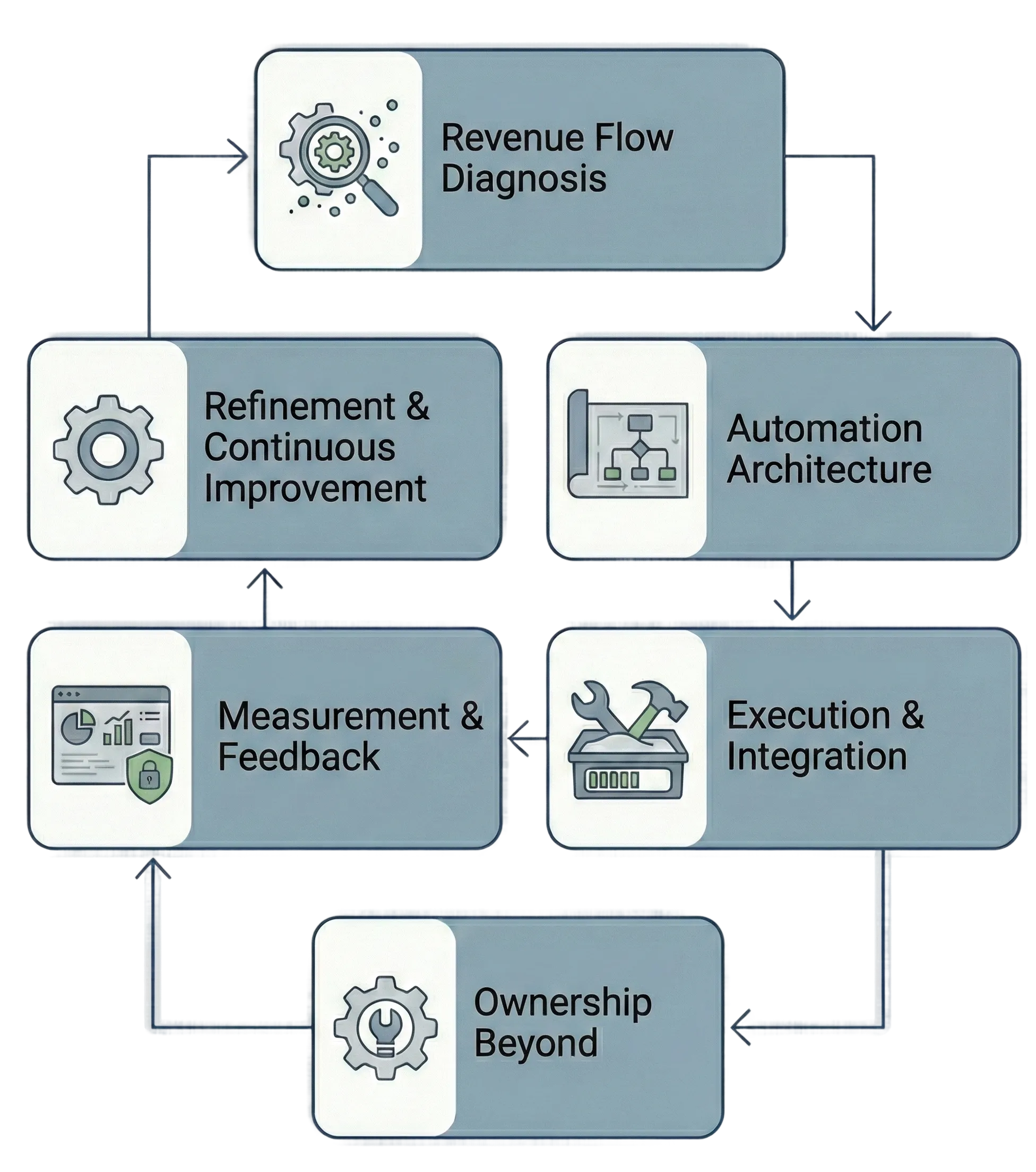
Before anything is automated, we map how revenue moves today.
This includes identifying handoffs between marketing, sales, and operations, tracing how leads are handled at each stage, and locating points where delay, ambiguity, or loss occurs. Bottlenecks are rarely where teams expect them to be, and assumptions often differ across functions.
By diagnosing failure points early, we avoid automating broken processes and instead focus on the areas where a digital marketing strategy [internal link to digital marketing page] and structure will have the greatest impact.
Automation through workflow software only works when roles and ownership are clear.
We define what each tool is responsible for, where data lives, and how processes are enforced across systems. This includes establishing a reliable source of truth, aligning lifecycle stages, and designing logic that reflects how decisions should actually be made.
The goal isn’t to replace judgment — it’s to ensure judgment is applied consistently, without relying on manual intervention at every step.
With the architecture in place, we build the automation layer that connects everything together.
This often involves custom logic that reflects your specific revenue motion, disciplined integrations that avoid fragile dependencies, and orchestration that ensures systems act in sequence instead of isolation. We prioritize reliability and clarity over cleverness, so workflows remain understandable and maintainable over time.
Well-designed automation should fade into the background — quietly doing its job without constant attention. In some cases, this requires custom dashboards or internal web applications to surface revenue signals clearly.
Revenue systems are not static.
As go-to-market strategies change, markets shift, and teams evolve, automation needs to adapt. We design systems with feedback loops that make performance visible and optimization continuous. Signals replace guesswork. Adjustments are informed by data, not urgency.
This allows revenue operations to improve steadily over time — without introducing chaos or starting from scratch.
Artificial Intelligence is a powerful accelerator for revenue, but only if it is constrained by logic. We don't use AI to replace human judgment; we use it to process data at a scale that humans cannot, surfacing the "needle in the haystack" signals that drive actual conversion.
Static rules (e.g., "Director" = 10 points) are brittle. We deploy AI models that analyze thousands of behavioral data points to determine true intent.
Pattern Recognition: Our models look beyond job titles to analyze behavioral velocity—spotting the subtle difference between a "browser" and a "buyer" based on engagement depth and frequency.
The "Why" Factor: We believe in Explainable AI. We don't just give a lead a score of 95; we expose the why (e.g., "Score driven by recent pricing page visit and technical doc download"), empowering the sales rep to frame the conversation correctly.
Most reporting looks backward. We use AI to look forward.
Pipeline Risk Detection: We implement predictive models that analyze deal velocity and communication sentiment to flag "At-Risk" opportunities before they slide into the next quarter.
Conversion Forecasting: By analyzing historical win rates against current pipeline characteristics, we help leadership move from "Gut-Check" forecasting to probability-based revenue modeling.
More automation is not always better. If not carefully architected, AI can pollute your CRM with garbage data.
The "Black Box" Danger: We avoid opaque "AI Magic" tools that hide their logic. If a sales leader cannot audit why a decision was made, they cannot trust the system.
Over-Automation Risks: We strictly limit AI in high-touch scenarios. We never allow AI to fully automate "Closing" communications where nuance and human empathy are the deciding factors. AI prepares the intel; humans take the shot.
When revenue performance feels harder to manage than it should, the issue is often less about effort and more about systems. Disconnected tools, manual handoffs, and unclear attribution can quietly limit pipeline efficiency.
Share some context about your current go-to-market setup, and we’ll help you understand whether revenue automation could create leverage — or if there are underlying gaps to address first.
We build revenue-engineered B2B websites designed for search authority, buyer intent, CRM integration, and measurable pipeline growth.
Unlock the power of custom software development in Michigan. Craft tailored solutions for your unique business needs and drive growth.
Web Apps drive growth, efficiency, and user engagement with tailored web solutions.
Don't just rank—dominate the Answer Engines. We replace outdated SEO with Search Intelligence, optimizing your data for AI, LLMs, and Revenue Growth