
Custom Software Development
Unlock the power of custom software development in Michigan. Craft tailored solutions for your unique business needs and drive growth.

We help mid-market B2B companies replace disconnected SaaS tools, outgrown ERPs, and manual workflows with a single, custom-built operational platform. Whether you're stitching together five systems that don't talk to each other, recovering from a failed ERP implementation, or still running critical processes on spreadsheets — we build intelligent, AI-assisted software that consolidates your operations, gives you full ownership of your data, and scales without per-seat licensing fees.

As companies grow, the work behind the scenes often grows faster than revenue. What starts as a few spreadsheets, shared folders, and point tools slowly turns into a web of manual processes that are hard to see, harder to manage, and nearly impossible to scale.
Teams end up re-entering the same data in multiple systems. Reports take days to compile and are already outdated by the time decisions are made. Simple operational tasks require workarounds, approvals pile up, and small errors quietly compound into bigger problems.
At this stage, many companies respond by hiring more people. But headcount rarely fixes the root issue. It adds cost without removing friction, and it locks inefficient processes deeper into the business.
Operational bottlenecks don’t usually feel like “technology problems.” They feel like constant interruptions, slow decisions, and a sense that the business is harder to run than it should be. That’s the signal that manual operations have reached their limit.
If this feels familiar, the diagnostic assessment at the bottom of the page can help you quickly assess whether automation is likely to create real leverage for your operations.
Business Process Automation (BPA) is not about replacing people or adding more tools. It’s about redesigning how work moves through the business so routine operations happen automatically, consistently, and with far less manual effort.
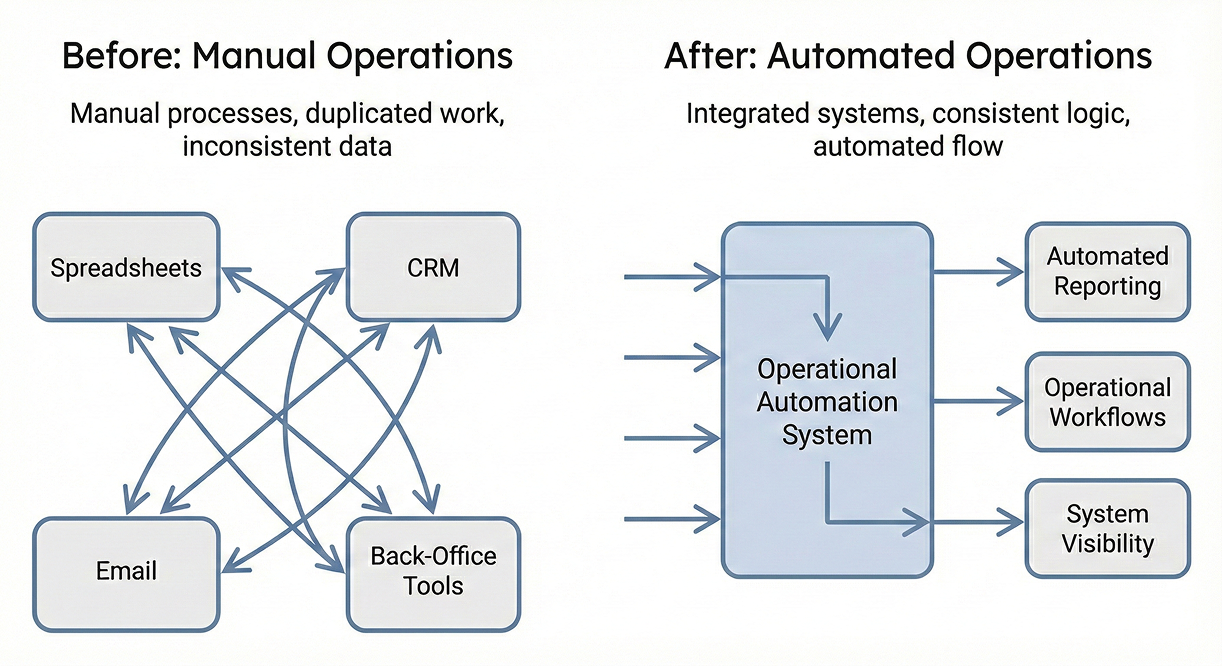
Automation is often misunderstood as a collection of scripts or no-code workflows. Those tools can be useful early on, but they tend to break as complexity increases. Edge cases appear. Data lives in more places. Exceptions become the norm.
True business process automation goes deeper. It connects systems at the data level, enforces logic consistently, and adapts as processes evolve. The goal isn’t to automate a single task—it’s to remove entire categories of repetitive work from day-to-day operations.
AI becomes valuable in automation when decisions aren’t purely rule-based. Tasks like classification, prioritization, anomaly detection, and interpreting unstructured inputs benefit from AI support. Used correctly, AI reduces manual review and speeds up decisions without introducing fragility.
At the same time, not every process needs AI. Many operational workflows are best handled with clear logic and deterministic systems. Effective automation combines both approaches—using AI where judgment is required and traditional automation where consistency matters most.
The result is an operational system that doesn’t just move faster, but operates with fewer errors, clearer visibility, and far less day-to-day friction.
We don't build automation for automation's sake. We build it to remove friction from your most critical value chains. Examples of operational automation include reporting, data workflows, and back-office processes where speed and accuracy are non-negotiable.
If several of these processes apply to your business, the diagnostic assessment at the bottom of the page can help you determine whether automation is worth pursuing now — or later.
Stop paying your highest-paid staff to copy-paste data into Excel. Through custom software development, we create data engines that automatically query your SQL/NoSQL/MongoDB databases, CRMs, and SaaS platforms.
The Result: Your Monday Morning Report is generated at 6:00 AM, analyzed by AI for anomalies, and emailed to your executive team before they wake up.
Your CRM, ERP, and Project Management tools shouldn't be islands. We build secure, custom middleware that keeps your data synchronized with workflow process automation in real-time.
The Difference: Unlike rigid "connector" tools, our intelligent agents can handle data transformation—cleaning messy inputs and formatting them correctly for the destination system without breaking.
The back office is often where scale breaks. We automate the repetitive, high-stakes tasks that slow down cash flow.
Use Cases: Automating invoice generation from timesheets, reconciling payments against bank feeds, and routing purchase orders for approval based on custom logic tiers are just some of the web app development features we can do.
Reduce the noise in your inbox. We can deploy NLP-driven agents that can read incoming tickets or emails, understand the intent (e.g., "Urgent Billing Issue" vs. "Feature Request"), and route them to the exact right person—or draft a response for you to approve.
Don't wait for the monthly meeting to find out that something is wrong. We can build "Watchdog Agents" that monitor your operational data 24/7.
The Value: Receive instant alerts via Slack/Teams when profit margins dip below a threshold, inventory runs low, or a project budget is pacing to overburn.
Most businesses start with off-the-shelf SaaS tools. It’s the smart way to begin. But as you scale, the very tools that helped you grow can become the bottleneck that holds you back. You eventually hit a ceiling where "subscription fatigue" sets in, and tool sprawl creates more work than it saves.
No-code platforms (like Zapier or Make) and standard SaaS integrations are excellent for simple tasks. However, they struggle with the complexity of a maturing business.
Standard tools handle the "Happy Path" well. But when an order has a special discount code, or a customer record is missing an email, off-the-shelf bots often fail silently.
Stacking multiple single-purpose apps to solve one problem creates a fragile web of dependencies. If one app updates its pricing or API, your entire workflow collapses.
When you rely entirely on third-party platforms, your data is locked in their ecosystem, making it difficult to analyze or move.
These platforms don’t offer services such as software discovery, which ensure that your needs are met and that their platform truly solves the business operations you’re trying to automate.
Custom software isn't for every problem. It is an investment reserved for high-value operations where generic tools fall short. You are ready for Moonello’s custom automation with custom software development when:
Your workflow requires logic deeper than simple "If/Then" statements (e.g., probabilistic matching, historical data analysis, or multi-step approvals).
You are processing thousands of records, where per-transaction fees on SaaS platforms become more expensive than building your own engine.
You need to connect modern cloud apps with legacy on-premise ERPs or SQL databases that don't have public API connectors.
The process you are automating is your "Secret Sauce." You shouldn't rent the core technology that differentiates your business; you should own it.
This is often the point where teams pause and ask whether custom automation is the right next step. The diagnostic assessment below is designed to help answer that question objectively.
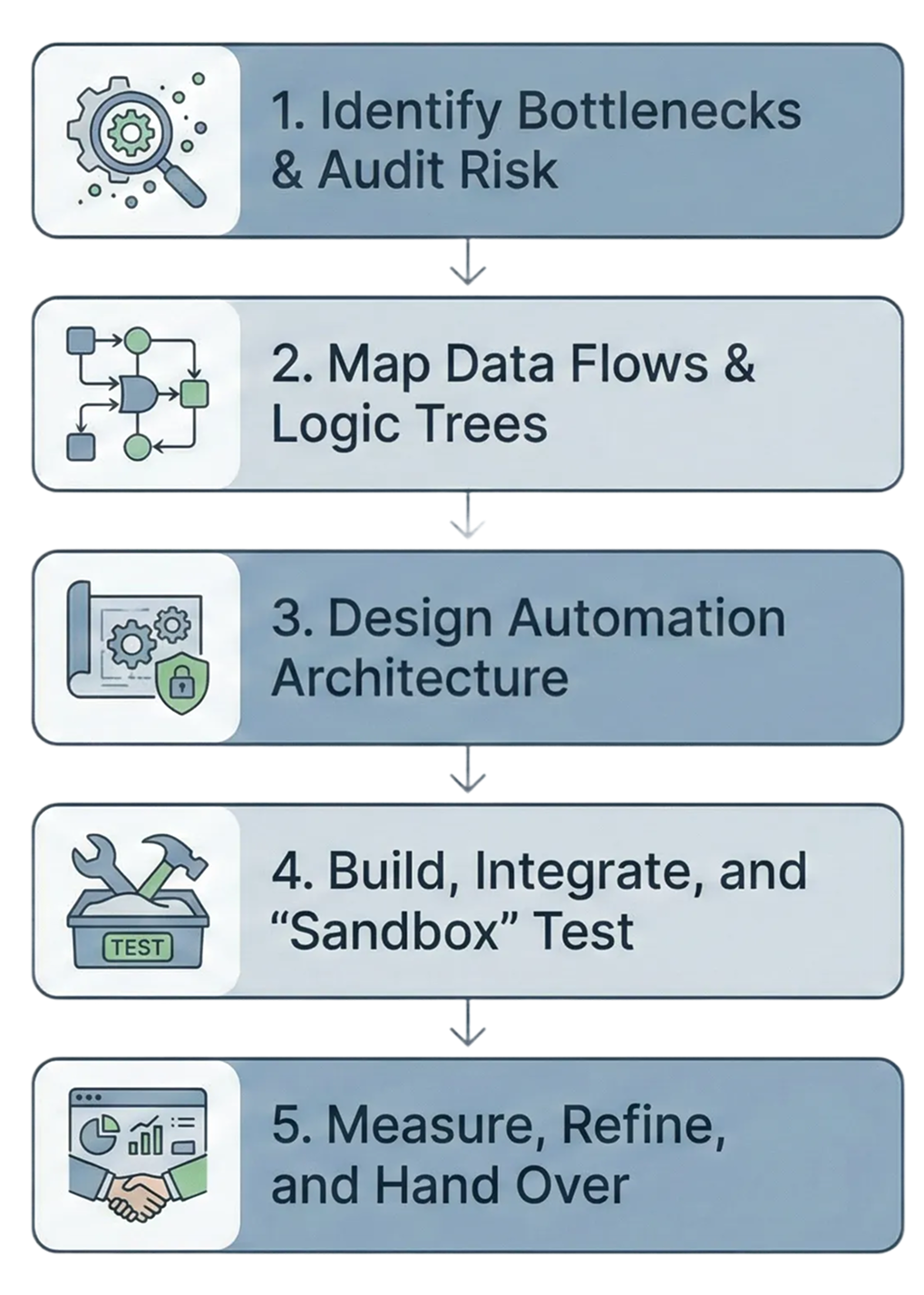
We do not believe in "move fast and break things" when it comes to your operations. We believe in measured, architectural change starting with an impactful software discovery phase. Operational automation projects follow a structured process designed to minimize risk while maximizing system resilience.
We don't automate a broken process; that just makes the mess faster. We start by auditing your current manual workflows to find the "Silent Killers"—redundant steps, shadow IT, and data fragmentation. We calculate the cost of inaction and define clear KPIs for success.
Before writing a single line of code, we blueprint your entire data ecosystem. We map exactly where data originates (Source of Truth), how it transforms (Logic), and where it must land (Destination). This visual schematic ensures we handle edge cases—like missing fields or API timeouts—before they happen.
We architect a secure environment for your agents to live in. We select the right "Brain" (LLM) for the job and design the Middleware Layer that connects your tools securely.
Security First: We define Role-Based Access Controls (RBAC) and encryption standards to ensure your data never leaks during transit.
We develop your system in a tenant-isolated environment. We run "Stress Tests" using historical data to see how the agents perform under high volume.
The Sandbox Rule: We never deploy to production until the system has processed thousands of test transactions with 99.9% accuracy.
Automation is not "set it and forget it." Once live, we implement Telemetry—dashboards that monitor the health of your agents. We track error rates, processing speed, and cost-per-task. Finally, we hand over the "Keys to the Car," training your internal team on how to monitor and manage their new digital workforce.
If you’re considering automation but want to avoid unnecessary complexity, the diagnostic assessment below can help clarify whether this approach fits your current stage.
We don't "sprinkle AI" on processes just to say it’s there. We treat Artificial Intelligence as a specific architectural component used to solve ambiguity. Traditional software is perfect for rules; AI is perfect for context.
The biggest bottleneck in most operations is Unstructured Data—emails, PDFs, Slack messages, and customer notes. Traditional automation cannot read these.
We can deploy AI models that act as a "Triage Nurse" for your data. They read incoming unstructured text, classify the intent (e.g., "This invoice is past due" vs. "This invoice is incorrect"), and route it to the correct department. That’s true workflow process automation.
The Value: Your team stops acting as data routers and starts acting as decision-makers.
In traditional automation, if a spreadsheet column header changes from "Client Name" to "Customer Name," the bot crashes. This fragility kills ROI.
We build Adaptive Agents that use semantic understanding to map data fields based on meaning, not just exact spelling. If the input format changes slightly, the AI understands the context and adjusts on the fly without breaking the workflow.
The value you get is "Self-Healing" workflows that require significantly less maintenance than standard scripts.
Part of our job is telling you "No." We believe in using the right tool for the job to ensure stability and cost-control.
✅ When the task requires judgment, summarization, handling variable inputs, or parsing unstructured data (images/text).
❌ When the task is purely mathematical or requires 100% deterministic precision (e.g., calculating payroll taxes). For these tasks, we use rigid code, not probabilistic models.
If your team is spending too much time on manual processes, disconnected systems, or reporting workarounds, it may be a sign that operational automation could create leverage.
Share a bit about your current challenges and goals, and we’ll take a look at whether automation makes sense now — or if there are foundational steps worth addressing first.
Unlock the power of custom software development in Michigan. Craft tailored solutions for your unique business needs and drive growth.
Web Apps drive growth, efficiency, and user engagement with tailored web solutions.
Unlock the potential of software discovery in Michigan. Dive deep, find the right tools for your Michigan business, and streamline your operations for tomorrow.
Elevate user satisfaction with seamless interfaces and memorable UI/UX experiences tailored for your Michigan business.
Eliminate data silos with high-fidelity API architecture. Moonello engineers secure, low-latency integrations between legacy infrastructure and modern cloud environments. Scalable data synchronization for the mid-market.