


Agentic AI
Learn more

We help B2B companies embed AI into their operations, products, and revenue systems. Whether it's automating support workflows, augmenting sales processes with intelligent agents, or integrating AI capabilities into your systems, we focus on measurable outcomes in environments where reliability and security aren't negotiable.

Most business systems break down quietly.
At first, everything works. Processes are documented. Automations are in place. People know how to handle exceptions. But as volume increases and complexity creeps in, cracks start to form.
What used to feel manageable begins to feel fragile.
Many critical workflows still rely on people making repeated judgment calls — reviewing tickets, prioritizing leads, classifying requests, interpreting data, or deciding what happens next.
That works when volume is low. It fails when volume grows.
Decisions slow down. Outcomes become inconsistent. Important signals get missed, not because people aren’t capable — but because humans don’t scale linearly with system complexity.
Traditional automation depends on predefined rules. If this, then that.
That approach works well for stable, predictable processes. But real systems aren’t stable or predictable for long. Edge cases multiply. Inputs vary. Context matters.
The more rules you add, the more brittle the system becomes. Eventually, automation stops helping and starts getting in the way.
As systems grow, people are forced to step in more often — to interpret, override, route, or decide.
This creates hidden bottlenecks:
- Work queues back up
- Decisions get delayed
- Knowledge lives in people’s heads
- Visibility disappears upstream and downstream
The system technically functions, but it no longer moves at the speed the business requires.
Most internal systems are very good at executing instructions. They are far less capable of handling variability, ambiguity, or change.
They can’t adjust priorities dynamically. They can’t interpret nuance. They can’t support decisions without constant human intervention.
This is the moment many teams feel the strain: Everything works — but it’s harder than it should be.
This is the problem Applied AI is designed to address — not by replacing people or rewriting systems, but by embedding adaptive intelligence where judgment, prioritization, and interpretation no longer scale.
Applied AI is often misunderstood because it’s usually presented as a product, a tool, or a layer you “add” to the business. That framing breaks down quickly in real environments.
In production systems, AI is rarely the thing users interact with directly. It’s a capability embedded inside workflows, applications, and decision paths. It supports how work gets done: requests are routed, data is interpreted, priorities are set, exceptions are handled, etc.
When AI is treated as the product, it becomes fragile. When it’s treated as a capability, it becomes useful.
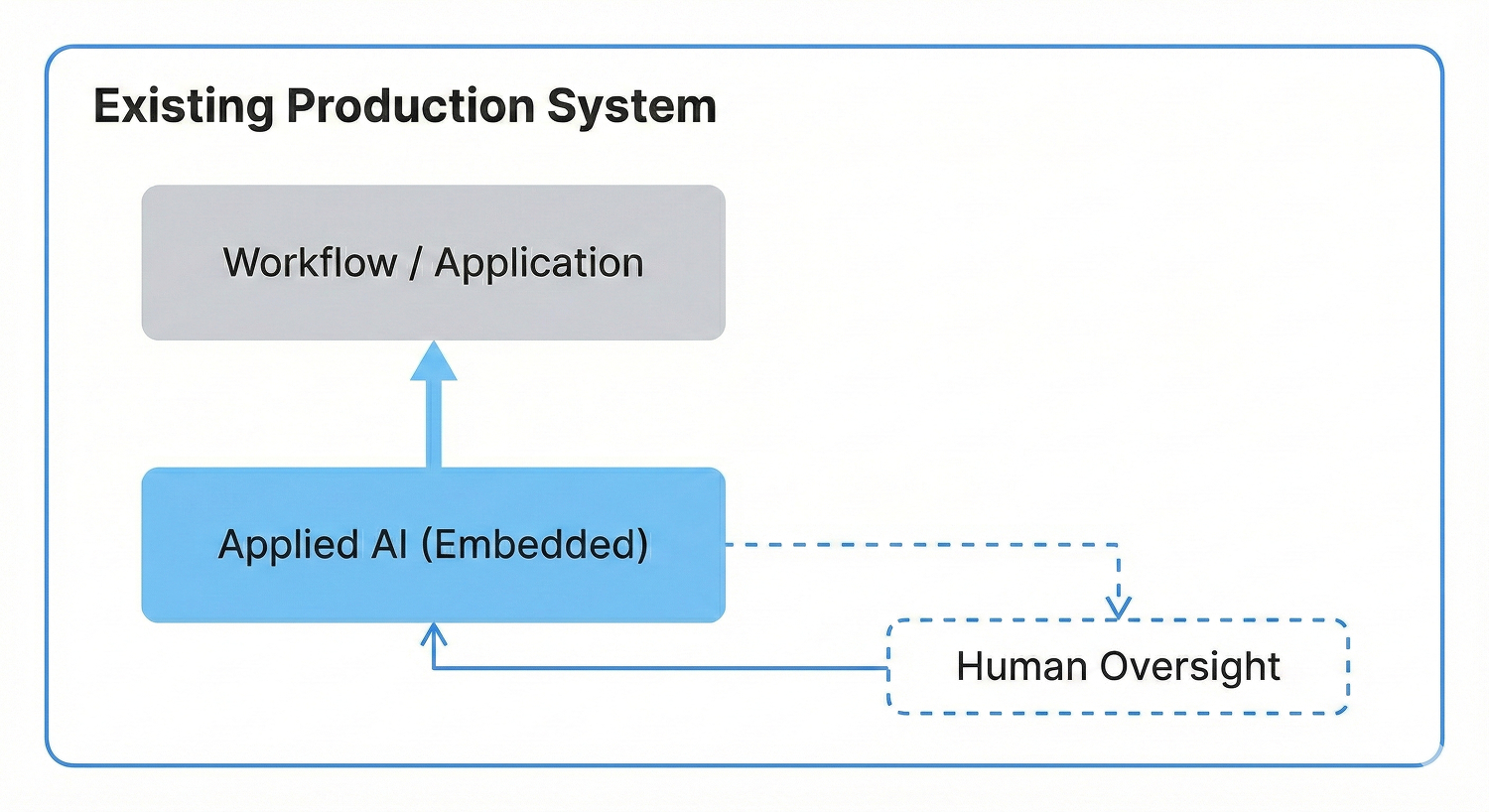
Applied AI is not proof-of-concept demos, internal copilots with no ownership, or isolated tools that live outside core systems. Those efforts can be valuable early on, but they don’t survive contact with production reality. Applied AI exists where systems already matter — where uptime, correctness, and trust are non-negotiable.
The real value of AI shows up when it’s embedded directly into operational workflows, customer-facing products, internal decision loops, and revenue and reporting systems. Instead of asking people to “use an AI tool,” applied AI augments the systems they already rely on — quietly improving outcomes without changing how work flows through the business.
Once AI moves into real systems, different rules apply. Reliability matters. Security matters. Ownership matters. Someone has to maintain it, monitor it, and be accountable for how it behaves over time.
Applied AI is designed with those constraints in mind from the start — not retrofitted after the fact.
Applied AI does not replace existing systems. It coexists with them. It works alongside established databases, operational software, internal tools, and human decision-makers.
The goal isn’t to rip and replace — it’s to extend what already works with adaptive intelligence, where static logic and manual judgment no longer scale.
Applied AI is most effective when it’s used in very specific places — not everywhere, and not all at once.
The common thread across successful implementations is leverage: situations where a small amount of intelligence removes a large amount of friction.
Many systems depend on sorting and routing work correctly — tickets, requests, leads, records, or events.
When volume is low, humans handle this well. As volume increases, consistency drops and delays grow.
Applied AI can support these workflows by classifying inputs, prioritizing what matters most, and routing work to the right place automatically — without relying on rigid rules that break as soon as conditions change.
Some decisions are too nuanced for if/then logic, but too frequent to be handled manually. Examples include:
determining next-best actions
flagging anomalies or risks
interpreting incomplete or conflicting signals
supporting time-sensitive decisions
In these cases, applied AI doesn’t replace decision-makers — it augments them, surfacing context and recommendations where static automation can’t keep up.
As systems grow, knowledge fragments. Critical information lives across documentation, databases, tickets, emails, internal tools, etc. Applied AI enables retrieval-augmented systems that can surface the right information at the right moment — grounded in your actual data — instead of forcing teams to search manually or rely on tribal knowledge.
Most organizations don’t run on a single system. Work moves across CRMs, internal tools, spreadsheets, and operational software.
Applied AI can help coordinate actions across these systems — understanding context, triggering follow-ups, and managing handoffs without brittle integrations or excessive human oversight.
Real-world inputs are inconsistent. Requests vary. Data is messy. Exceptions are normal.
Applied AI adds flexibility where traditional automation fails — allowing systems to adapt to variation without collapsing under edge cases or requiring constant rule updates.
These are the moments where applied AI creates real leverage — not by adding complexity, but by removing friction where systems and people struggle to scale together.
Applied AI creates the most value when it’s used deliberately — not everywhere, and not by default. In practice, the difference between AI that helps and AI that hurts comes down to context, readiness, and risk.
More intelligence does not automatically mean better systems.
Over-automation introduces new failure modes: opaque behavior, hidden dependencies, and increased maintenance burden. In many cases, a smaller, well-designed system outperforms a more complex one that’s harder to reason about.
Applied AI is most effective when it’s used selectively — in places where adaptability is required and the system can absorb that complexity responsibly.
This restraint is intentional. Applied AI isn’t about using the newest tools — it’s about choosing the right tool for the system, the data, and the risk profile involved.
Applied AI works best when systems already exist and the problem is not whether work should happen, but how decisions are made within that work.
Common signals that applied AI is a good fit include:
Meaningful data already flowing through systems
Decisions that happen frequently and affect outcomes
Inputs that vary enough to defeat rigid rules
Human judgment being applied repeatedly at scale
Bottlenecks caused by review, prioritization, or interpretation
In these environments, applied AI can reduce friction, increase consistency, and support better decisions without forcing teams to change how they operate.
There are many situations where AI adds complexity without delivering value.
Applied AI is often the wrong tool when:
Deterministic logic already solves the problem well
Data is sparse, unreliable, or constantly changing
Every decision must be fully explainable in advance
The cost of a wrong decision is unacceptable
The system lacks clear ownership after launch
In these cases, simpler automation — or no automation at all — is usually more effective.
Getting AI to work in a demo is easy. Getting it to hold up inside a real system is not.
Production environments introduce constraints that prototypes rarely face — uptime requirements, security expectations, operational ownership, and the reality that systems evolve over time. Applied AI has to be designed with those realities in mind from the start.
In real systems, AI rarely operates in isolation.
Applied AI works best when it supports human decision-making rather than attempting to replace it entirely. This includes clear handoff points, escalation paths, and the ability for people to review, override, or intervene when needed.
Human-in-the-loop design reduces risk, improves trust, and makes systems more resilient when conditions change.
Once AI is part of a production system, visibility matters. Teams need to understand how often AI-driven actions occur, where confidence is high or low, when outputs start to drift, and how decisions impact downstream systems
Without monitoring and observability, AI becomes a black box — and black boxes are difficult to trust in environments where reliability matters.
AI systems don’t stay static.
Data changes. Usage patterns shift. Models that performed well early can degrade quietly. Applied AI requires ongoing lifecycle management — validating outputs, retraining when appropriate, and adapting as the system evolves.
Designing for this upfront avoids brittle systems that decay unnoticed after launch.
Every applied AI system needs a safe failure mode. When confidence drops, data is missing, or unexpected inputs appear, the system should degrade gracefully — falling back to deterministic logic or human review instead of producing unreliable outcomes.
These safeguards are essential for maintaining trust and preventing small issues from becoming operational incidents.
Applied AI must fit into existing architecture.
That means integrating with current data models, workflows, and services rather than living as a disconnected layer. AI should extend systems that already work — not force a redesign just to accommodate new technology.
Someone must be responsible for how the system behaves, how it changes, and how it impacts the business over time. Applied AI is not a one-time implementation — it’s an ongoing capability that must be maintained, evaluated, and refined.
Production AI requires long-term ownership. This is what separates AI that looks impressive from AI that holds up after launch — when real users, real data, and real consequences are involved.
Applied AI only works when it’s applied in context. We don’t treat it as a standalone initiative or a separate workstream. Instead, we embed it where it strengthens systems that already exist.
How that looks depends on the problem being solved.
Operational systems rarely fail because they stop executing. They fail because they encounter variability — exceptions, handoffs, edge cases, and volume spikes that force people back into the loop.
In these environments, applied AI helps systems adapt without adding complexity. It supports routing decisions, flags anomalies, and assists with exception handling when processes no longer follow clean paths. Rather than replacing workflows, AI absorbs variability so teams spend less time managing breakdowns and more time operating with clarity.
The result is operational flow that holds up under pressure instead of becoming brittle as scale increases.
In software products, applied AI becomes part of how users interact with the system — not a feature bolted on after the fact.
Here, AI supports knowledge-driven experiences, contextual recommendations, and intelligent assistance inside real user workflows. It’s designed alongside the rest of the product, with clear boundaries, predictable behavior, and long-term maintainability in mind.
This approach allows products to feel smarter without becoming opaque — preserving user trust while introducing adaptive capabilities where static logic falls short.
Revenue systems tend to suffer from signal overload. Too many inputs, too much noise, and too many decisions happening too slowly or inconsistently.
Applied AI helps make sense of that volume. It supports prioritization, extracts meaningful signals across channels, and assists with routing and forecasting where rigid scoring models struggle. Instead of forcing teams to constantly refine rules, AI adapts to patterns as they emerge — with oversight and controls in place.
This allows growth and revenue teams to act with greater confidence, even as inbound activity scales.
Across all three areas, applied AI is never the goal.
It exists to support system outcomes — improving reliability, clarity, and execution without undermining accountability. AI is introduced only where it strengthens the system as a whole, and only in ways the organization can own and sustain over time.
That discipline is what keeps applied AI useful long after launch.
Applied AI is most effective when systems are already in production and reliability matters. It’s not about experimenting — it’s about reducing friction and supporting decisions inside systems that already exist.
A brief conversation can help determine whether applied AI makes sense now, where it would add leverage, and what constraints should guide the approach before any work begins.