
Your Software Stack Shouldn't Cost More Than Your Team.
You're paying six figures a year for platforms that don't fit, seats nobody uses, and integrations that barely work. There's a better way to run your business.
If This Is What Your Software Stack Looks Like…
…then you're spending more to work around your tools than you spent to buy them.
But you don't have to rip everything out overnight.
Most mid-market companies don't start with a bloated SaaS stack. It builds up gradually — a CRM here, an ERP there, a payroll system, a project tool, a reporting layer duct-taped on top. Each one solved a problem. Together, they created a new one: fragmented data, runaway costs, and a business that runs on workarounds instead of workflows. We help companies replace that patchwork with one system — built around how your business actually operates.
The Problem Isn't Any Single Tool, It's the Stack
Most growing companies don't have a "bad software" problem. They have a "too many disconnected platforms" problem.
Over time, the stack grows. Salesforce for CRM. NetSuite or QuickBooks for accounting. HubSpot for marketing. Paycor for payroll. Monday.com for projects. A handful of spreadsheets holding it all together. Each tool charges per seat, per month, whether anyone uses it or not.
What started as "the right tool for the job" quietly becomes the most expensive and least understood part of the business.
Where the Cost Actually Lives
You're paying for seats nobody uses — Industry data shows 53% of purchased SaaS licenses go completely unused in any given month. That's not underutilization. That's waste you're paying for on autopilot every renewal cycle.
Your tools don't talk to each other — You're spending $25K–$100K+ per integration just to get platforms to share data they should never have been separated from in the first place. And those integrations break.
Customization costs more than the software itself — Half of all ERP implementations fail the first time. The ones that don't typically cost 3–4x the original budget in customization, consulting, and rework. You're paying SaaS prices for something that still has to be rebuilt to fit your business.
Your team works around the system, not with it — When the software doesn't match how the business actually operates, people build workarounds. Spreadsheets. Manual exports. Copy-paste workflows. The system becomes a checkbox, not a tool.
You don't own any of it — Every dollar you spend on SaaS licensing is rent. The vendor can raise prices, sunset features, or change terms, and you have no leverage because your data and workflows are locked inside their platform.
Most Companies Don't Calculate What Their Stack Actually Costs
If the tools "work" , the invoices get paid, the CRM has contacts, the reports sort of run, it feels manageable.
Until someone adds up the annual licensing, the implementation costs, the integration fees, the consultant invoices, and the internal time spent making everything talk to each other.
For a mid-market company with 100–250 employees, the 3-year total cost of ownership for a typical SaaS stack (licensing, implementation, and hidden costs) runs $530K–$730K+.
And that's before you count the time your team spends working around the system instead of working in it.
That's not a technology expense. That's a second headcount line item hiding in your software budget.
Why Companies Keep Paying for Software That Doesn't Fit
Most leaders know the stack is bloated. The reason it stays that way isn't ignorance, it's rational caution.
When the business runs on these platforms, even imperfectly, the risk of changing feels greater than the cost of staying.
Migration sounds like a nightmare.
The last implementation was painful.
Nobody wants to be the person who broke the system that "worked well enough."
So the stack grows. Contracts auto-renew. Workarounds calcify. And the cost compounds silently.
The Common Concerns We Hear
"We already invested too much to switch." The sunk cost feels real. But every renewal is a new decision , and the switching cost is often less than 2 years of what you're already paying.
"Custom software sounds expensive and risky." It did, five years ago. AI-accelerated development has fundamentally changed the timeline and cost of building custom systems. What used to take 18 months now takes 5–12.
"Our team won't adopt something new." They're not adopting what you have now, either. 53% of seats go unused. The difference is that a custom system is built around how your team actually works, not how a vendor thinks they should.
"What if the dev team disappears?" Vendor lock-in is the real disappearing act. With custom software, you own the code. With SaaS, you own nothing, and the vendor can change the terms anytime.
"We'll deal with it at renewal." Every renewal without a plan is another year of compounding waste. The best time to evaluate was last renewal. The second best time is now.
These concerns are understandable.
They're also the reason most companies keep paying 2–3x what they need to for systems that deliver a fraction of what they should.
How We Replace Your SaaS Stack With a System You Own
Building custom software doesn't mean starting from scratch or going dark for 18 months. It means designing one system around your business — built in phases, tested with real users, and deployed without disrupting operations.
Our Approach
This Is Not a Science Project
We don't build software for the sake of building software. Every engagement starts with understanding whether a custom system actually makes sense for your business. Sometimes it does. Sometimes the answer is "optimize what you have." We'll tell you honestly.
We map your workflows, identify waste, and design the system before writing a line of code. This phase produces a clear scope, timeline, and budget — not a vague proposal.
You'll know exactly what you're getting and what it costs before committing to a build.
Built module by module, tested with real users, deployed with zero disruption.
We don't hand you a finished system and walk away.
Each module is validated against your actual operations before the next one starts. Your team uses the system as it's being built, not months after.
Continuous improvement, new features, and scaling as your business grows.
Unlike SaaS, where you wait for a vendor to prioritize your feature request, your system evolves on your timeline. New AI capabilities, workflow changes, additional modules, all on your terms.
1. Discovery & Architecture (4–6 Weeks)
2. Build & Implementation (5–12+ Months)
3. Ongoing Support & Evolution
The Real Cost: SaaS Stack vs. Owning Your System
Most companies are surprised when they see the math side by side.
The Typical SaaS Stack
NetSuite (30–50 seats): $58K–$89K/yr in licensing alone
Salesforce (10–20 seats): $21K–$42K/yr
HubSpot, Paycor, project tools: $10K–$40K/yr
Integration costs: $25K–$100K+ per connection
Annual consulting & customization: $50K–$150K/yr
3-Year Total Cost of Ownership: $530K–$730K+
The Hidden Costs Nobody Tracks
53% of purchased seats go completely unused
3–4x budget overrun is the average ERP implementation cost
50% of ERP implementations fail the first time
Your team spends 60% of their day on coordination and workarounds, not skilled work
Every dollar spent is rent, you own nothing at the end
The real cost isn't the invoice. It's the compounding inefficiency.
A Custom System You Own
Discovery & architecture: $25K–$35K
Build & implementation: $150K+
Ongoing support & evolution: $60K–$110K/yr
Zero per-seat licensing — add 50 employees without adding $50K in costs
AI/RAG data layer built in from day one
You own the code, no vendor lock-in, no sunset risk
3-Year Total Investment: $305K+, and you own it.
Most companies are already spending $450K–$900K+ over three years just to maintain what they have.
A custom system replaces that spend with something you actually own, and that compounds in value instead of cost. Every improvement stays. Every feature serves your business.
And when AI capabilities evolve (they will), your system is ready, because your data is clean, accessible, and yours.
Why the "Build vs. Buy" Math Is Changing Fast
For the past 15 years, "buy SaaS" was the default answer. The math made sense: faster to deploy, lower upfront cost, someone else handles maintenance.
That math is breaking down, and the companies paying attention are already moving.
Pressure bullets:
AI has collapsed the cost of building custom software — What used to require 18 months and a seven-figure budget can now be built in 5–12 months at a fraction of the cost. AI-assisted development accelerates every phase — architecture, coding, testing, deployment. The "custom is too expensive" objection is a 2019 argument in a 2026 world.
SaaS pricing is getting worse, not better — Vendor price hikes averaged 12% in 2025. AI add-ons and consumption-based pricing are creating cost volatility mid-contract. Per-seat licensing punishes growth. Every new hire comes with a software tax.
Your data is your most valuable asset — and it's locked in someone else's platform — AI, automation, and predictive operations all depend on accessible, structured data. When your data is scattered across 15 SaaS tools, none of those capabilities are possible. A unified system makes them inevitable.
Vendor lock-in is a strategic risk, not just an inconvenience — Vendors can sunset features, force migrations, raise prices, and change APIs. You have no leverage because switching costs are designed to be prohibitive. Owning your system eliminates that dependency entirely.
Your competitors are figuring this out — The companies that build proprietary operational systems — designed for their specific workflows, their specific data, their specific competitive advantages — create moats that SaaS-dependent competitors can't match.
None of these require panic. Together, they make the "just renew" default more expensive, and the custom alternative more accessible, than at any point in the last decade.
Start With a Conversation, Not a Contract
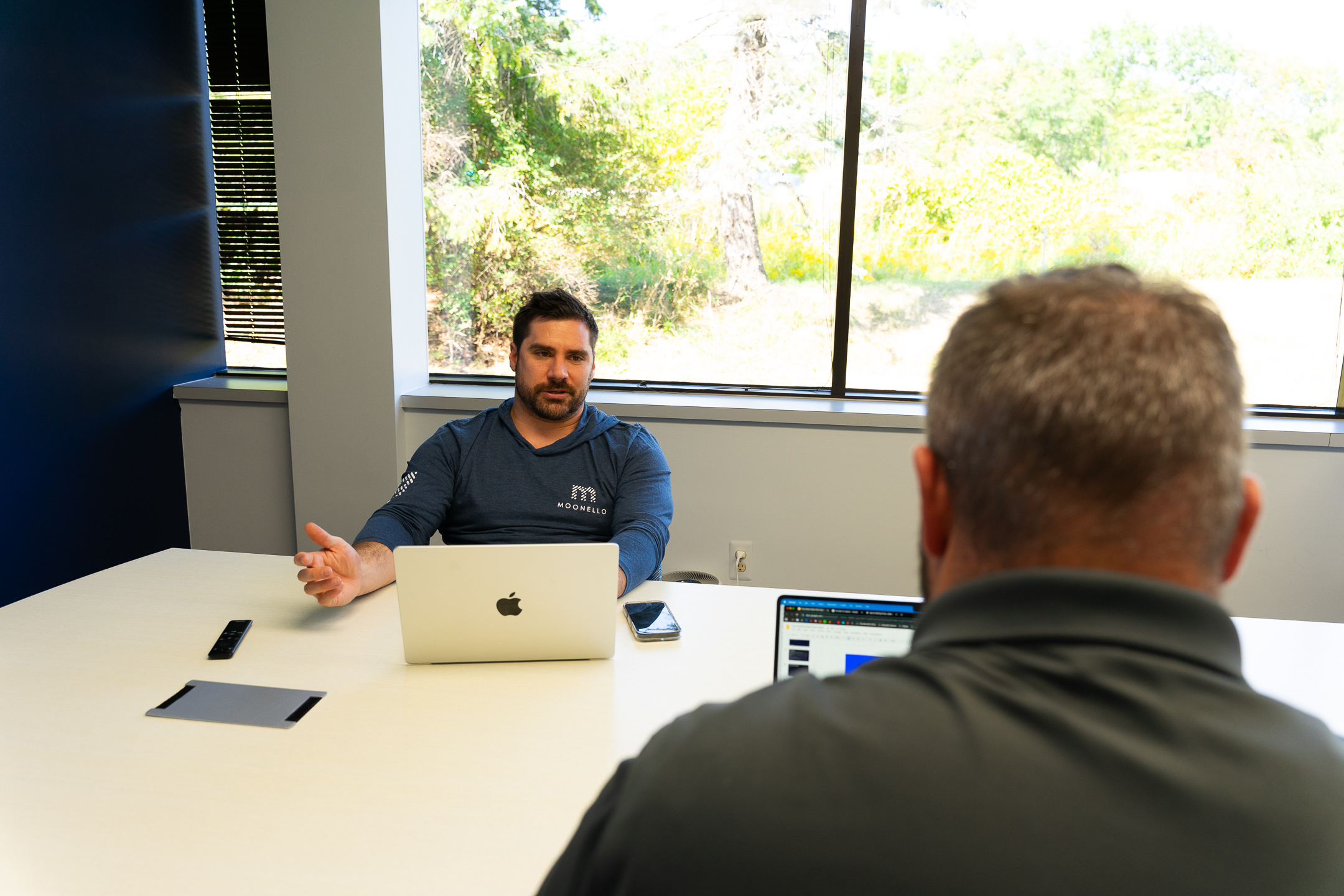
A straightforward conversation to understand your situation, what you're running, what's keeping you up at night, and whether custom software even makes sense for your business.
What You'll Get
Honest assessment of your current stack's true cost
Clear-eyed view of whether custom makes sense, or doesn't
No pitch, no proposal, no obligation
Engineers, not salespeople
Why Work With Moonello
Building a custom operational system requires more than coding ability — it requires understanding how businesses actually run, how teams actually work, and how to transition from fragmented tools to a unified platform without breaking anything.
Our work is led by engineers who build real production systems for companies that can't afford downtime. We're not a dev shop that writes code to spec. We're a partner that starts with your business problem and works backward to the right technical solution.
Engineers, not project managers — You work directly with the people designing and building your system. No telephone game. No agency overhead.
AI-accelerated development — We use AI at every stage, architecture, development, testing, deployment. This isn't a buzzword. It's how we deliver production-quality systems in months instead of years, at costs that compete with SaaS total cost of ownership.
Zero per-seat economics — Your system doesn't get more expensive as your company grows. Add users, add departments, add locations, no licensing surprise.
You own everything — The code, the data, the architecture. No vendor lock-in. No sunset risk. No terms that change without your consent.
Built for adoption, not for demos — We design around how your team actually works. That's why our systems get used, because they replace friction instead of adding it.
Common Questions
Let's Look at Your Stack Together
If your software costs keep climbing but the value doesn't, or if you've been wondering whether there's a better way to run your operations, we're happy to take a look and tell you plainly whether custom makes sense for your business.